


October 2026
Month 20xx
Jacob Marion
Charmaine Gooden
Highlights
- Monica Lewis, a Jamaican immigrant, became a folk hero in Toronto's Eglinton West neighbourhood through her beauty supply store, which served the Black community's needs.
- Her husband, George, operated a music label and retail in the basement, fostering local talent like Liberty Silver, the first Black woman to win a Juno Award.
- Miss Monica is celebrated as a pioneering businesswoman and community leader in Little Jamaica.
- She is compared to other trailblazing Black women entrepreneurs like Viola Desmond and Madam CJ Walker.
Beginning of article
When Toronto’s Black and Caribbean communities struggled to find beauty products suited to their needs, Monica Lewis saw an opportunity to build something of her own.
The entrepreneur behind Monica’s Cosmetic Supplies Ltd. helped establish one of Ontario’s early businesses dedicated to Black hair care, creating a space where specialized products, beauty expertise and community came together.
Known throughout the neighbourhood as “Miss Monica,” and affectionately as the “Queen of Little Jamaica,” she became a familiar and enduring presence for generations of Black and Caribbean Torontonians

Early Life and Career
Born on November 1, 1940, Lewis grew up in Brown’s Hall, St. Catherine, Jamaica. The daughter of farmer Nathaniel Harvey and housekeeper Alice Harvey, Lewis came from humble beginnings.
As a young woman, she was given an opportunity that would alter the course of her life. With only one family member able to go abroad, Lewis was chosen to leave Jamaica for England, where she would study nursing.
Lewis completed her training and began working as a nurse in the late 1950s, but her ambitions extended beyond healthcare. Hoping to one day run a business of her own, she also studied hairdressing, eventually becoming skilled enough to teach it herself.
While in England, Lewis met and married George Lewis, who shared her entrepreneurial ambitions. Together, the couple left England for Canada in 1968, settling in Toronto as the city’s Caribbean community continued to grow. The couple had two sons, Derrick and George “Junior” Jr., while building a personal and business partnership that would span decades.
Once in Toronto, Lewis saw an opportunity. Drawing on the hairdressing skills she developed in England, she and George opened “Monica’s Cosmetic Supplies Ltd.” at 1553 Eglinton Avenue West.
This brought their respective interests under one roof. Lewis developed the storefront beauty business that would become most closely associated with her name, while George built the music side of the operation. He ran a record shop and music label in the basement, becoming known throughout the neighbourhood as “George the Record Man.”


Lewis’ beauty business shared the space with George’s record operation, bringing Black beauty, Caribbean music and community life together under one roof.
Upstairs, the smell of hair and beauty products filled the space while reggae bass travelled through the floorboards from the record shop below.

Monica’s Cosmetic Supplies developed into much more than a commercial storefront. Customers came for hair products and salon services, but stayed for conversation, advice and connection. For Caribbean immigrants building new lives in Toronto, the shop became a place where old relationships could unexpectedly be rekindled and new ones formed. Its place within the neighbourhood became so familiar that “Meet me at Monica’s” entered the local vocabulary.
Lewis was central to that atmosphere. Warm, welcoming and inquisitive, she took a personal interest in the people who came through her door. She might ask about someone’s zodiac sign, their family history or whether they needed advice. She was known for helping strangers and neighbourhood residents in need.
Few things, however, defined Lewis as much as her work ethic. She rarely missed a working day and continued going into the store for as long as she physically could. Although Monica’s was technically closed on Sundays, her near-constant presence inspired jokes that she seemed to be behind the counter 24 hours a day, eight days a week.

Fashion and Diversity
For Lewis, beauty and business were closely tied to community. Arriving in Toronto with hairdressing expertise developed abroad, she entered the industry at a time when few stores in Canada properly catered to the hair and beauty needs of the city’s growing Black and Caribbean population. Even fewer of these businesses were Black-owned.
She recognized the gap early. Drawing on her experience as a hairdresser, she began expanding beyond salon services to offer products specifically suited to Black hair and beauty. Monica’s would eventually become one of Ontario’s earliest businesses dedicated to Black hair care and, for a time, one of the few beauty-supply destinations of its kind in Toronto.
The store carried everything from shampoos and wigs to cosmetics and specialized hair-care products for men and women. For customers who couldn’t find these products elsewhere, Monica’s offered more than convenience. It was a Black-owned space where customers could access specialized knowledge and products without having to explain their hair, appearance or cultural needs.
That scarcity brought customers from well beyond the neighbourhood. People travelled from across Toronto, Southern Ontario and elsewhere in the province for products, hair services and expertise not easily found closer to home. Over time, the shop became a destination for entire families and generations of customers.
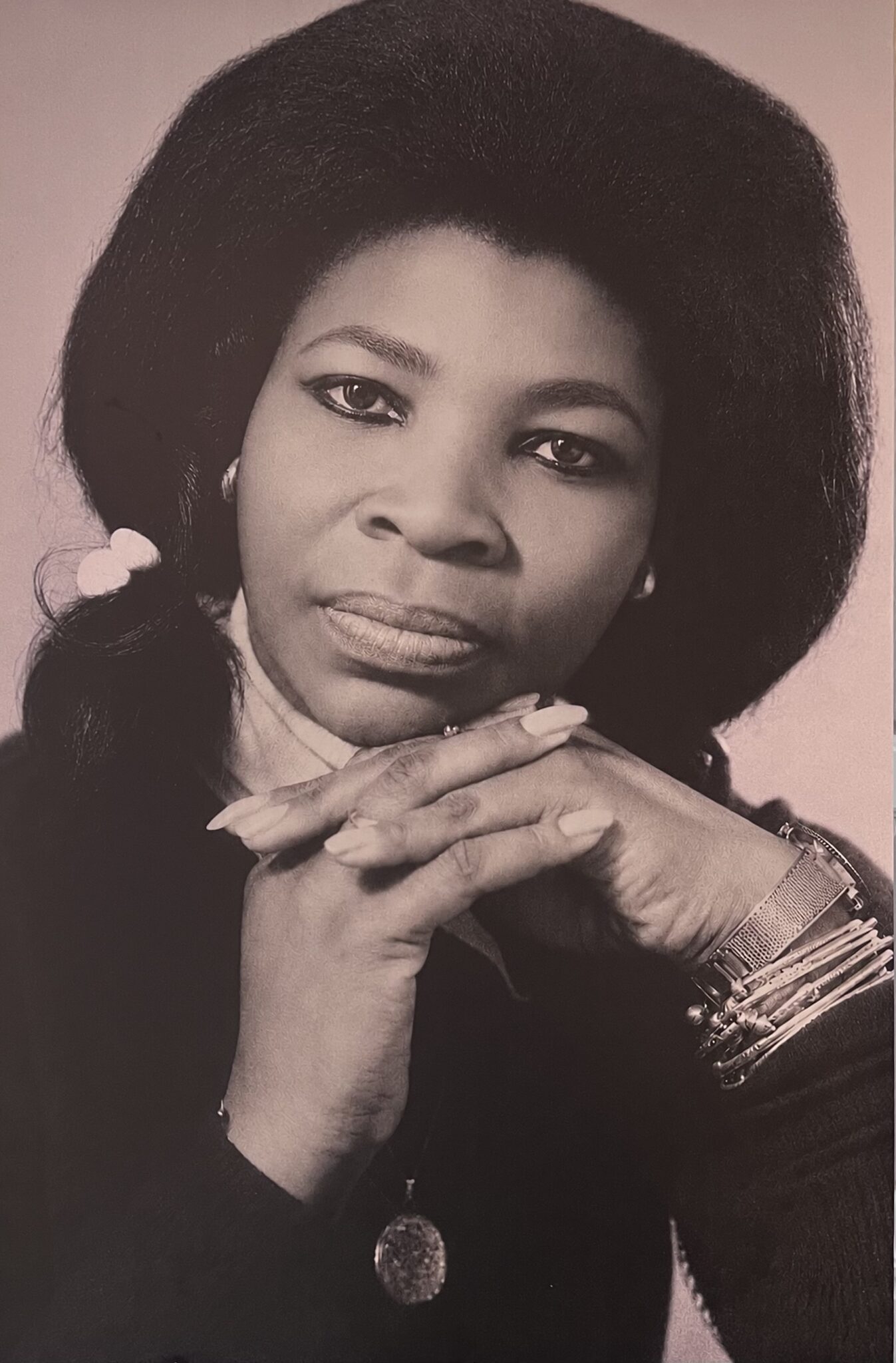
Lewis herself was as distinctive as the business she built. Known for her red lipstick and larger-than-life hairstyles, she became as much a part of the store’s visual identity as the products in its windows.
Inside and out, Monica’s reflected the community it served, from its beauty products and storefront displays to mannequins dressed in bejewelled mas costumes and elaborate Caribbean carnival headpieces. The displays made the shop feel as much like a cultural space as a beauty business.
Influence and Legacy
Lewis’ influence on Little Jamaica extended far beyond the beauty products and salon services she offered. She provided mentorship and advice to other women in business, especially about balancing marriage and work.
Itah Sadu, award-winning author and co-owner of Toronto’s A Different Booklist, paid tribute to Lewis at her funeral, recalling advice she gave about prioritizing family over community . “We live together, we work together, and you told me, ‘Itah, you and your husband are the marriage… You’re not married to the community, so love him. Look at how George and I have stayed the course all these years.’” Sadu thanked Lewis for showing how a couple can work together as a team, build a business and raise a family.
The building at 1553 Eglinton Avenue West became part of her legacy in its own right. Lewis’ beauty business shared the space with George’s record operation, bringing Black beauty, Caribbean music and community life together under one roof. Upstairs, the smell of hair and beauty products filled the space while reggae bass travelled through the floorboards from the record shop below.
In its busiest years, the basement became a destination for musicians, collectors and music fans searching for Jamaican and Caribbean records that were difficult to find elsewhere in Toronto. George also operated the “Monica’s Production” record label from the space. In 1979, Mr. Q, also known as Jay W. McGee, recorded and released “Ladies Delight” through the label, a recording widely cited as the first known Canadian hip-hop single.
At Lewis’ funeral, Juno Award-winning singer Liberty Silver reflected on the shop’s role in her own musical beginnings. “George was kind enough, and loving enough, to recognize that I had a voice. And that’s really where my voice came from, that record shop,” says Silver.
He also gave her the opportunity to understand the music business, not just how records were made, but how they were sold. “Those same records that came out of Monica and George’s record shop are still playing today, on YouTube and all over the internet,” she adds.
Its cultural footprint continued to last. Lewis’ storefront appeared in music videos by Canadian artists k-os and Kardinal Offishall, further connecting the familiar Eglinton West business to Toronto’s Black music culture. For people who grew up around the neighbourhood, Monica’s became as much a marker of place and identity as it was a store.

Although Monica’s was technically closed on Sundays, her near-constant presence inspired jokes that she seemed to be behind the counter 24 hours a day, eight days a week.
Lewis remained committed to that neighbourhood even as Little Jamaica changed around her. Years of Eglinton Crosstown construction devastated foot traffic and contributed to business closures along the street. By 2018, Lewis and George sometimes came into the shop just to sit, with so little business that she recalled days when she didn’t make a single sale.
Still, she continued opening the store. Even when there was little money to be made, Lewis wanted to remain available in case somebody needed a product, wanted advice or simply stopped in to say hello. Her persistence through construction, redevelopment pressures and declining sales became another part of the legacy she left behind.
In 2025, Mayor Olivia Chow recognized Lewis’ contributions to Toronto in a letter, thanking her for decades of entrepreneurship and community-building.
In her later years, Lewis stepped back from the business as family increasingly demanded her attention. After George suffered a stroke, she spent approximately five years caring for him at home. On May 20, 2026, Lewis died in her sleep at her home in Woodbridge, Ontario. She was 85.
More than half a century after Lewis first began building a life in Toronto, the space she helped create remains tied to Little Jamaica. From Black beauty and entrepreneurship to music, mentorship, faith and community-building, her legacy lives not only in the business she sustained for decades, but in the people and neighbourhood that continue to carry its influence forward.
References and related links:
- https://www.cbc.ca/news/canada/toronto/little-jamaica-monica-lewis-death-9.7225690
- https://mountpleasantgroup.permavita.com/site/MonicaLewis.html
- https://www.thestar.com/news/gta/community-remembers-beloved-matriarch-of-little-jamaica-monica-lewis-who-died-at-86/article_f594981e-fa54-4136-8c29-06c5e26884f4.html
- https://www.theglobeandmail.com/canada/article-monica-lewis-matriarch-toronto-little-jamaica-community/
- https://jamaica-gleaner.com/article/news/20260611/monica-lewis-entrepreneur-heart-torontos-little-jamaica-dies
- https://www.youtube.com/watch?v=fj4ULvMl8uQ


